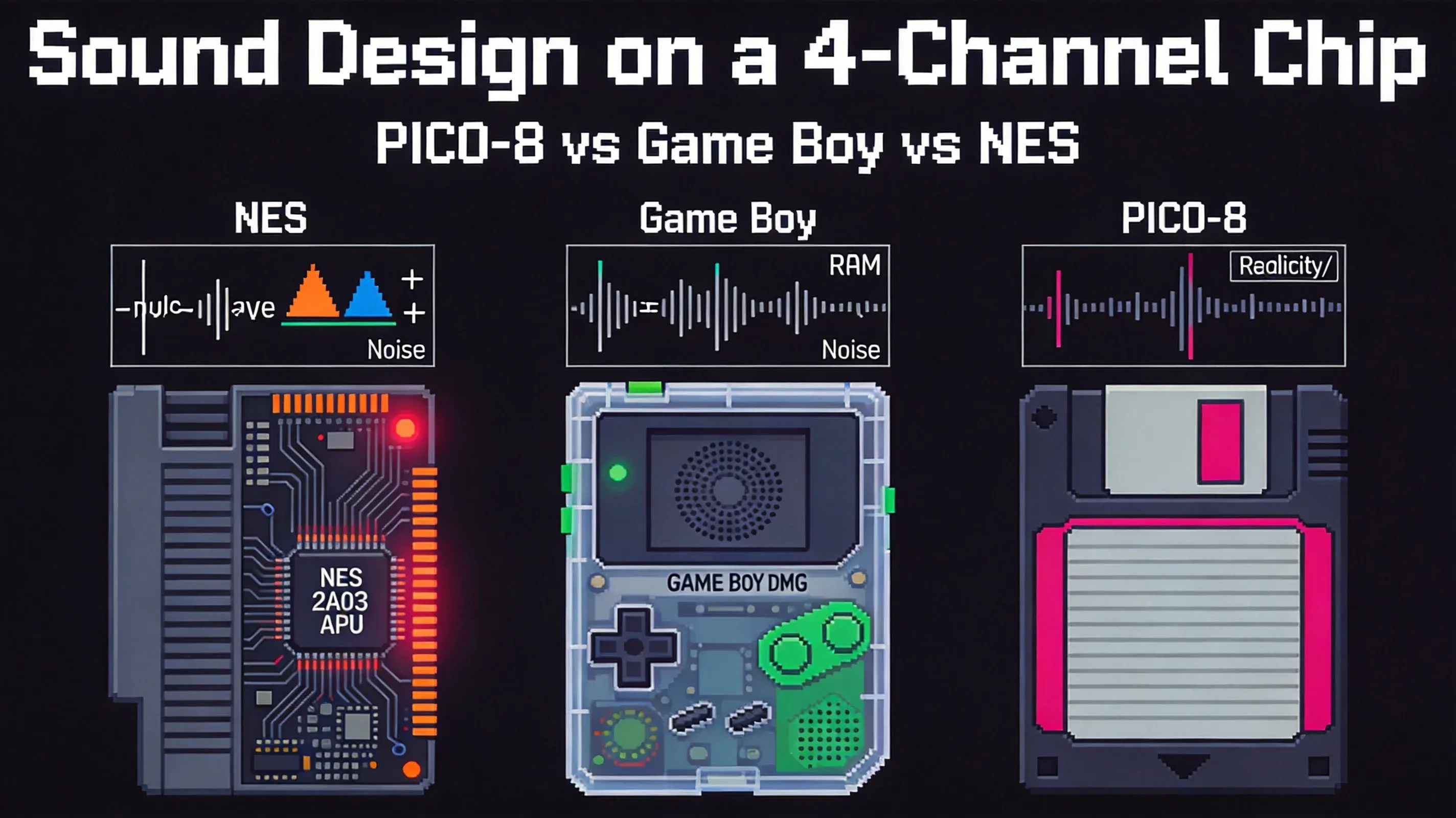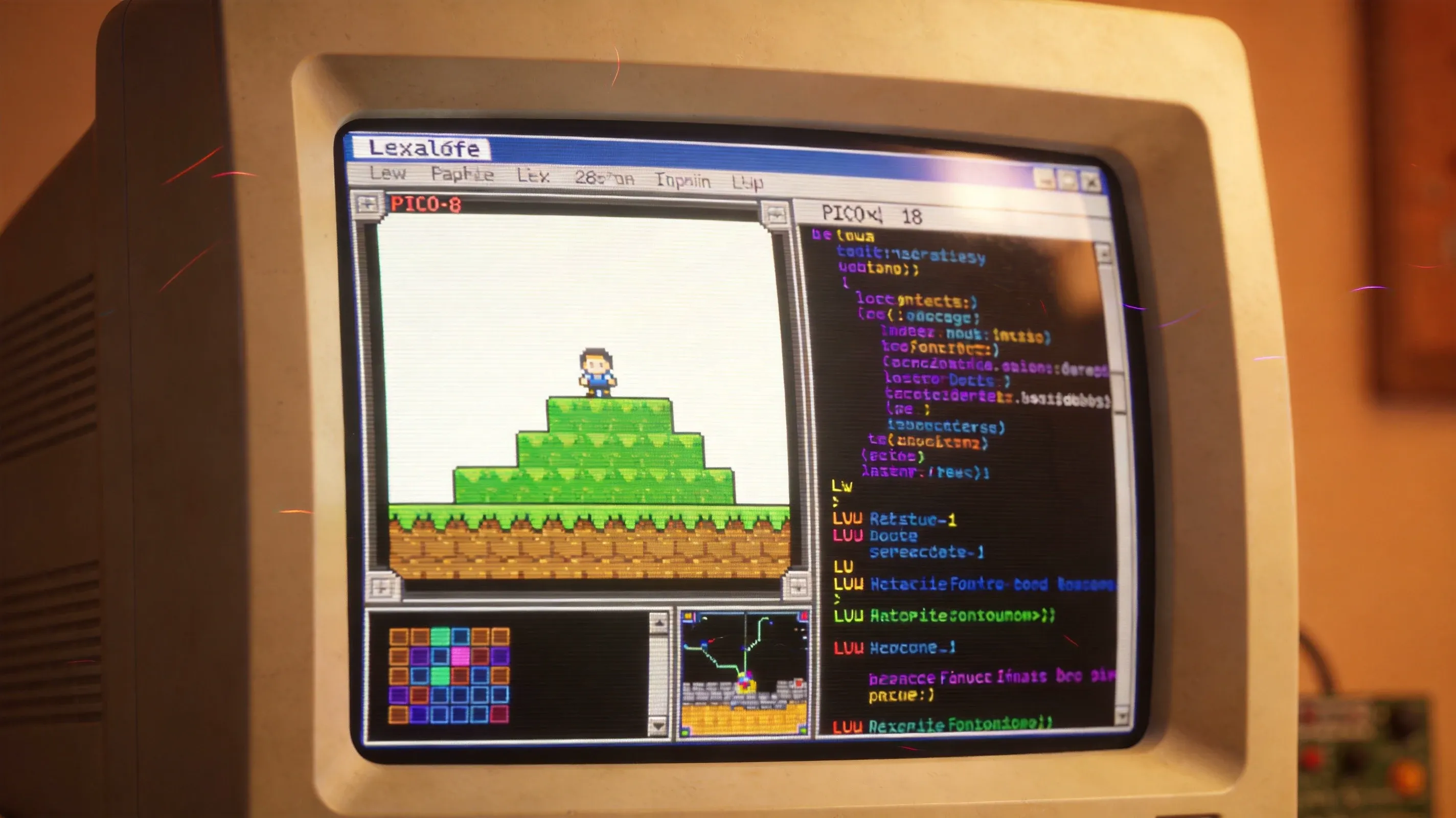
TL;DR: PICO-8 is a "fantasy console" — a deliberately limited virtual machine that emulates hardware that never existed. Built by a single New Zealander working in Japan, its 128×128 pixel canvas, 16 colors, and 32k cartridge cap could have been a gimmick. Instead, those constraints created a shared language for thousands of developers. The Lexaloffle BBS, where every cartridge's source code is readable, turned a tool into a community. Celeste began as a four-day PICO-8 jam game before becoming a million-selling indie landmark. In 2026, PICO-8 is still active — not as a museum piece, but as a living platform with ongoing jams, mobile emulators, and a spiritual successor in Picotron.
§1 What is a Fantasy Console
What if a game console didn't exist? Not a cancelled prototype or a failed Kickstarter — something that never left the schematic stage, never shipped in plastic, never gathered dust under a television. And then someone built it anyway, purely in software, and gave it harsher limits than any real console from the 1980s. That is the strange premise of PICO-8. A "fantasy console" is exactly that: a virtual machine that emulates constraints, not historical hardware. The screen is 128 by 128 pixels. The palette holds 16 colors, each chosen by the developer Joseph White (known as Zep) from a much larger space of possibilities. The cartridge — a single .png file that encodes both graphics and code — is capped at 32 kilobytes. The audio has four channels. The scripting language is a stripped-down version of Lua. [Source 5: Handwiki PICO-8 entry]
These numbers are not a spec sheet. They are a philosophy. Zep could have made the palette 64 colors. He could have bumped the resolution to 256×256. He could have given the cartridge 256k, which by 2015 standards was still absurdly small. He chose these limits deliberately. Zep has framed the 32k cartridge cap — a constraint tighter than what most retro consoles of the 1980s shipped with — as a kind of forced creative closure. The idea, in his telling, is that the cartridge fills up on purpose. When a developer runs out of space, the project ends. You ship it, or you optimize what you have, but you stop adding. The cap is a permission structure, not a technical limitation. [Source 2, paraphrased]
That last part is crucial. Most creative tools punish you for stopping. They offer infinite canvas, unlimited layers, a plug-in for everything. You never finish because finishing is an arbitrary decision, not a technical necessity. PICO-8 makes the decision for you. When the cartridge fills up, you ship. Or you optimize. Either way, you stop adding features and start calling it done. Zep has described PICO-8 as sitting outside real history — a kind of parallel-world machine whose hardware development took a different path from the consoles we actually had. [Source 2, paraphrased]
The term "fantasy console" now feels obvious — a category that has always existed. But Zep coined it in 2014, and it has since become industry standard. TIC-80 calls itself a "fantasy computer." Pixel Vision 8 uses the same framing. Each of these tools acknowledges PICO-8 as the ur-text. What I find interesting is that the category didn't exist before someone built the fantasy first. Acknowledging that "small and limited" sounds dismissive. But here's what actually happened: a community formed around a tool most people expected to vanish by 2017.
§2 Zep and the LEX500 Years
Joseph White — Zep — is a New Zealander, but he has lived and worked in Japan for most of his professional life. (Community profiles list him as "Pākehā" — a New Zealand European — age 46, with the self‑described profession "Fantasy Machine Designer.") That matters less for the technical details of PICO-8 and more for the cultural distance it created. Building a fantasy console from Tokyo, for a global audience, meant Zep was never quite inside the US-centric indie game discourse of the early 2010s. He didn't need to chase trends.
In the 2000s, Zep spent years building LEX500, a BASIC interpreter inspired by the BBC Micro's dialect. He shelved it. It was technically competent but lacked a hook. Then, around 2010, he started working on Voxatron — a voxel-based arcade game that he wanted to ship with built-in level editing tools. The editing tools grew. He pulled the music tracker and map editor from LEX500, renamed the bundle PICO-8, and initially intended it as a "minimal playground" to support Voxatron development. Zep has described the moment PICO-8 separated from Voxatron as a kind of recognition: a single word — cartridge — that did the work of a hundred design docs. The editor, the music tracker, the level format: none of it had to be explained, because a console plays cartridges. A fantasy console plays fantasy cartridges. The metaphor was the architecture. [Source 2, paraphrased]
The first public showing was on May 9, 2014, at the Pico Pico Cafe — a Japanese arcade and bar that shares the name by coincidence, not affiliation. The official release followed in April 2015. The copyright reads "2014-2015" because of that preview window. In the eleven years since, Zep has released regular updates, but the core constraints have never changed. I keep thinking about that 2014-2015 gap. A year of testing, of watching how strangers used the tool, of deciding whether to loosen the limits. He didn't. And somehow, that's the point.
§3 Pay-What-You-Want and the Indie Tool Economy
PICO-8 launched at $14.99. But Lexaloffle has always accepted payments between $5 and $100, a pay-what-you-want model that includes the full product at any price above the minimum. [Source 1: PICO-8 official site]
In 2026, that $14.99 buys you a downloadable application for Windows, Mac, Linux, and Raspberry Pi — all updates free, all built-in editing tools (sprite editor, map editor, sound and music trackers, code editor), plus access to the Lexaloffle BBS where every uploaded cartridge reveals its source code.
The question this section answers is boring on its face but culturally revealing: How does a single developer sustain a tool for a decade on $14.99?
The pay-what-you-want model means a significant fraction of users pay above the minimum. Some pay $30, some $100, treating the purchase as patronage. University game design courses adopted PICO-8 — New York University, University of Southern California, University of Utah, and dozens of others — which created institutional buyers. Lexaloffle's other products (Voxatron, and later Picotron) cross-sell into the same audience. Public profiles — including Zep's own self-description on community directories — list him as a "Fantasy Machine Designer," and the cadence of PICO-8 updates (most recently the v0.2.6b stable release in February 2024) suggests the tool is not a hobby project. [Source 4: Lexaloffle BBS profile / community bio]
The term "sustainable indie" has been done to death by content farms. But PICO-8 is one of the few creator tools that has managed to be simultaneously affordable, philosophically coherent, and financially stable. Most indie game engines from the 2010s went one of two directions: free but ad-supported or purchased by a larger company and bloated with features nobody asked for. PICO-8 is neither. It stayed small because staying small was the whole point. Most pay-what-you-want tools either price themselves out of the indie-developer market or quietly fold within five years. PICO-8 did neither. But the model isn't really the point — Zep's decade of living in Japan, the small Voxatron income, and his tolerance for slow growth are. The business model worked because the life behind it could afford to wait. For the community that formed around the tool, that model created trust. Nobody was being harvested for data. Nobody was being locked into a subscription. You paid once, and you owned the fantasy console forever.
I think about the Lexaloffle paywall-less BBS — every cartridge is downloadable, every source is readable, no login, no email, no upsell — and I keep coming back to the same observation: this is what "indie" used to mean, before the word got load-bearing. PICO-8 has not changed its economics in eleven years. The term "indie" has changed around it.
§4 Lexaloffle BBS and the Community
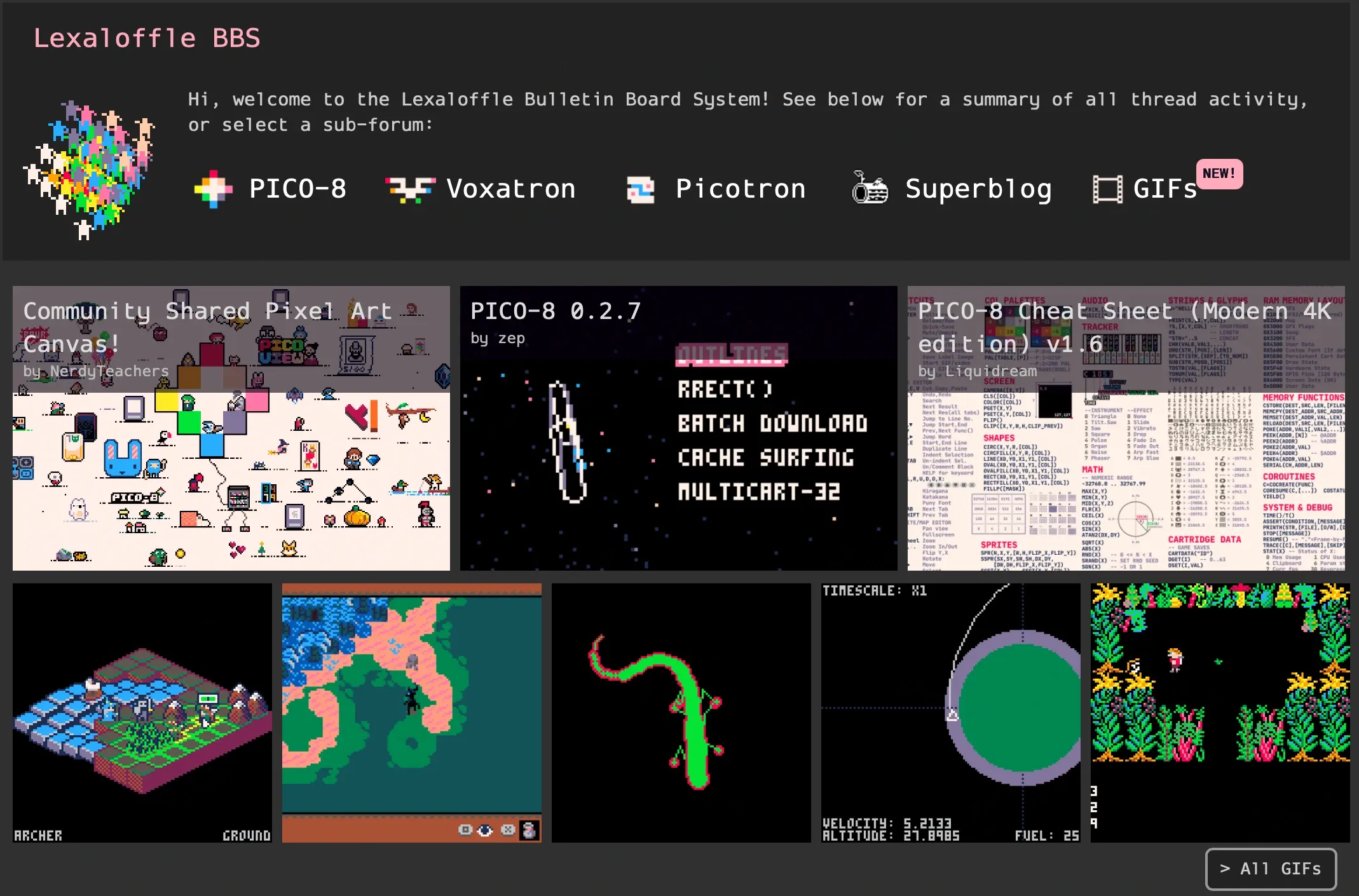
Inside the PICO-8 application is a button labeled SPLORE. Click it, and you are browsing the Lexaloffle BBS — a cartridge repository that predates the modern indie game feed by several years. You can upload your own game, play anyone else's, and — this is the critical feature — view the source code of every cartridge. "Read the source" is not a power-user option. It is the cultural centerpiece of the entire project. In Unity or Unreal or GameMaker, user projects are typically closed. You can decompile, but it is an adversarial act. In PICO-8, opening a stranger's game and reading their Lua is a first-class feature, built into the same interface that runs the game. An eight-year-old can do it. A professional game developer can do it. Academic interest followed the community. A 2025 ACM paper on "Anti‑Games, Fantasy Consoles, and the Rise of Speculative Game Development" treats PICO-8 as a case study in constraint‑driven design. [Source 3]
Open PICO-8 for the first time and the editor window feels small — not because the screen resolution is low, but because the interface is cramped, with everything competing for the same 128×128 simulated canvas. But the second thing that becomes obvious is SPLORE. A first session with the tool looks like this: half an hour of playing strangers' unfinished platformers, reading their collision code, copying their sound effect patterns. The user has not paid for a tutorial. They have paid for access to a library of working examples written by people who are, like them, trying to figure out how to make a character jump.
The hashtag ecosystem — #pico8 on Twitter, Bluesky, Mastodon — has been active since 2015. The visual aesthetic is instantly recognizable: a tiny pixel screenshot, the author's handle, sometimes a link to the BBS. It is its own genre of post, the indie game equivalent of a Polaroid. Annual game jams — the Picoware Jam, plus dozens of community-run jams on itch.io [Source 9] — produce a specific creative density that longer projects cannot match. A 48-hour jam with a 32k cap means you cannot add a crafting system. You cannot write dialogue trees. You can make a single mechanic work and polish it until it shines.
Tom Hall — co-creator of Doom, Commander Keen, and Anachronox — has been making PICO-8 games since the late 2010s. In a 2021 deep‑dive feature on PICO-8, Hall said developing for the platform was "the easiest development I've ever done," citing the all‑in‑one tooling and instant feedback loop. He also described the platform's appeal in terms that have become almost a community catchphrase: the constraints feel less like a wall and more like a "cosy space" — paradoxically freer than a blank canvas. "It's like an old, favourite sweater," he said. [Source 2]
The Lexaloffle BBS is, by any measure, a small community — small enough that the same handles show up in comment threads year after year, small enough that a single viral tweet can move the entire front page. Zep, by his own account, has spent more than a decade watching it stay small on purpose. That smallness became a feature, not a bug. When a community stays small for a decade, trust compounds. Drama is rare. Toxic behavior gets noticed and addressed quickly. And when someone makes something genuinely remarkable — like a four-day jam game about climbing a mountain — the entire community sees it at once. Which is, incidentally, how Celeste entered the room.
§5 Celeste Classic and the "Spillover" Effect
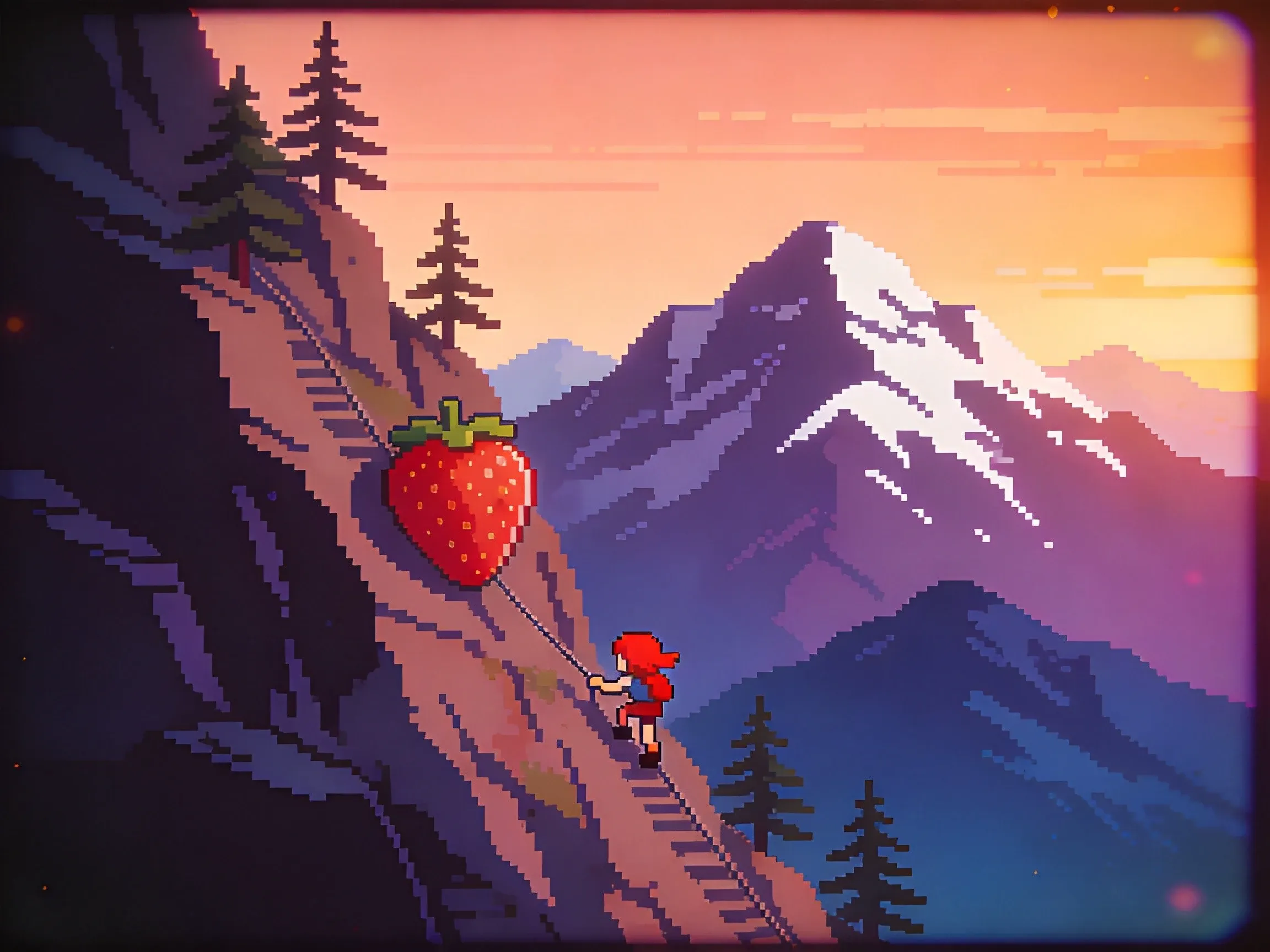
In January 2015, Maddy Thorson and Noel Berry made a PICO-8 game for a game jam. They called it Celeste. It took four days. It was thirty screens of mountain-climbing platformer with a dash, a climb, and a strawberry. The PICO-8 version — now called Celeste Classic — was popular on the Lexaloffle BBS. [Source 4]
Popular enough that Thorson and Berry decided to expand it. The full version of Celeste shipped in January 2018. It won the Grand Prize at the Independent Games Festival. It sold over a million copies. It was ported to every major platform, from Nintendo Switch to PlayStation to Xbox to PC. It is now considered one of the most important indie games of the 2010s, frequently cited alongside Braid, Fez, and Hollow Knight.
PICO-8 isn't a game engine that hosts finished games. It's a prototype environment whose prototypes sometimes become full games. The traffic between PICO-8 and the rest of the indie scene deserves a name. Call it "spillover."
The spillover goes two ways. First direction: PICO-8 jam → full indie release. Celeste is the canonical example, but there are dozens of others. CRTPlay hosts 16 PICO-8 games playable in a browser, including several that started as jam entries and later expanded. [Source 10: CRTPlay PICO-8 games browse page]
Second direction: full indie release → PICO-8 demake. In 2017, members of the SUPERHOT team made PICOHOT — a PICO-8 demake of their own commercial game. A commercial studio, voluntarily, demaking their own game into a 32k cartridge, was a signal that PICO-8 had cultural legitimacy, not just hobbyist status. You do not demake your own product into a toy unless you respect the toy.
The pattern repeats across a decade. Developers go to PICO-8 to prototype seriously — testing a core mechanic without the overhead of a full engine. And they go to PICO-8 to recreate playfully — boiling down a known game to its essential loops. Both directions produce cultural artifacts. Both directions feed back into the community. Most indie game engines of the 2010s — RPG Maker, GameMaker, Unity — launched thousands of games. PICO-8 launched hundreds. But a few of those hundreds changed the industry. The ratio is different because the constraints force a different kind of attention. You cannot hide a bad core loop behind particle effects or open-world side quests. You have 32k. You have sixteen colors. There is nowhere to hide a weak idea.
§6 Fantasy Console Family and Hardware Hacking
PICO-8 built a category. The imitators arrived quickly: TIC-80 ("a fantasy computer," open-source, with a larger palette and more forgiving limits), Pixel Vision 8, MEG-4, and dozens of smaller tools. Every new fantasy console cites PICO-8 as the origin. Some explicitly fork its philosophy; others compete on being less restrictive. But they all acknowledge that the term "fantasy console" came from a single New Zealander working in Japan.
The community built its own ecosystem around the tool. picoCAD — a low-poly CAD program that uses the PICO-8 palette and can export models into and out of the console — is a remarkable piece of constraint-respecting engineering. [Source 6] Third-party music trackers and sound effect editors exist because the built-in tools, while functional, are deliberately minimalist. Custom level editors and asset pipelines have been written in Python, JavaScript, and Rust. Physical and PDF fan zines — some called ZINE quite directly — publish tutorials, code listings, and developer interviews.
And then there is the hardware hacking. The PocketCHIP — a $49 portable computer that shipped with PICO-8 pre-installed — was the closest thing to a dedicated PICO-8 handheld. It is discontinued now, but the second-hand market remains active. Raspberry Pi has an official PICO-8 image. RetroArch — the open-source emulation platform — runs PICO-8 cores on everything from old PCs to the Miyoo Mini, a $60 handheld that fits in a coin pocket. The hardware breadth is the point. A 4 MIPS virtual machine running on a $4 microcontroller is, in a narrow technical sense, silly — but the silliness is the appeal. The community is recreating the same constraint-respecting engineering on every substrate it can find, because the constraint is the toy, not the substrate.
The most extreme example is the ESP32 — a 32-bit microcontroller running at 240 MHz. People have gotten PICO-8 games to run on these chips, which means emulating a 4 MIPS virtual machine on hardware designed for IoT sensors. Why? Because the constraints, once chosen, get layered. PICO-8's harsh limits become the ideal for further limit experiments. I'm not sure what to make of that, exactly. In most creative fields, people seek more power, more resolution, more flexibility. In the fantasy console world, people seek less — but less that is chosen, not imposed. The difference between playing PICO-8 on a gaming PC and running it on an ESP32 is the difference between playing a Game Boy game on original hardware versus emulating it on a graphing calculator. Both are valid. One tells you something about the game. The other tells you something about the person running it.
For readers in Brooklyn or Berlin or Bristol or Toronto — the kind of person who owns a soldering iron and regrets it — the hardware hacking scene is the entry point. For everyone else, the mobile emulators are the quiet revolution. I notice that nobody on the BBS treats the mobile emulators as a betrayal — they're treated as confirmation that the tool has outgrown the desktop. Zep has not said anything about this that I can find, which is consistent with how he has handled the rest of PICO-8: design once, document, then leave the rest to the community.
§7 Where PICO-8 Stands in 2026
On February 28, 2024, PICO-8 stable release v0.2.6b dropped. It is still the current version as of 2026. Two weeks later, on March 14, Zep released Picotron Alpha — a "fantasy workstation" rather than a console, with higher resolution, more colors, and a larger cartridge limit. Picotron is PICO-8's spiritual successor, but it is explicitly not a replacement. The two tools coexist. [Source 7]
The 2025-2026 mobile moment is quieter but meaningful. In 2025, Infinity, a PICO-8 emulator, released on Google Play. In February 2026, PicPic released on the App Store. [Source 8] Lexaloffle has not authorized an official mobile port. But emulators, which can play every PICO-8 cartridge ever made, are now on mobile. A 2015 desktop tool can be played in your pocket, and the developer did not have to lift a finger for it to happen. That is unusual. Most platform holders would have sent cease-and-desist letters. Zep has not. The emulators credit the original tool, link back to Lexaloffle, and drive sales of the desktop version. The system works.
Jam culture never stopped. Every year from 2015 to 2026, multiple PICO-8 jams have run. Some have run continuously for eight years or more. [Source 9] The community is smaller than the Steam early-access community, but it has never gone dormant. There is no off-season for PICO-8. If you want to see what a decade of PICO-8 community output looks like, CRTPlay hosts 16 PICO-8 games — including a couple that started as jam entries. [Source 10] And if you are curious about the deeper history of constraint-based game design, the NS-SHAFT blog post on CRTPlay tells the story of a 13-year-old's 222KB game, which shares more DNA with PICO-8 than either project's creators might have expected.
I keep noticing that constraint-based design attracts this kind of cross-pollination — small tools borrowing from other small tools, the same way indie bands cover each other. I've come to think of this as the quiet signature of constraint-based tools: they borrow from each other because they have to, not because they're trying to impress anyone.
PICO-8 is eleven years old. The thesis I started with was that constraints give a generation of developers a shared vocabulary. Eleven years in, that vocabulary has outgrown the tool — PICO-8 games now exist on mobile phones, on $4 microcontrollers, in arcade cabinets, and on whatever comes next. The fantasy console is no longer a fantasy; it runs on real hardware, played by real people, in plastic it never needed.
Key Takeaways:
- PICO-8 is a "fantasy console" with deliberately harsh limits: 128×128 pixels, 16 colors, 32k cartridges.
- Joseph "Zep" White, a single New Zealander working in Japan, built PICO-8 over a decade as a side project that became his primary work.
- The Lexaloffle BBS and its "read the source" feature turned the tool into a community where code is shared as freely as games.
- Celeste Classic began as a four-day PICO-8 jam game; the full Celeste sold over a million copies and won the IGF Grand Prize.
- In 2026, PICO-8 remains active through Picotron, mobile emulators, and ongoing jams — not as nostalgia, but as a living platform.
Sources:
- Source 1: PICO-8 official site
- Source 2: Zep's 2021 deep interview — Retro Gamer / Walker-Emig, Issue 221, 2021
- Source 3: ACM 2025 paper "Anti-Games, Fantasy Consoles, and the Rise of Speculative Game Development on itch.io" — dl.acm.org/doi/10.1145/3723498.3723739
- Source 4: Lexaloffle BBS
- Source 5: Handwiki PICO-8 entry — for verified dates and version numbers
- Source 6: picoCAD official site
- Source 7: Picotron official page
- Source 8: Infinity / PicPic emulator app store listings
- Source 9: A PICO-8 jam on itch.io or Lexaloffle BBS
- Source 10: CRTPlay PICO-8 games browse page
CRTPlay is not sponsored by Lexaloffle. All prices and specifications are public information as of 2026.