§1 When AI Learned to Play a 1990 Game
If you've never heard of NS-SHAFT, you're not alone. The game is 222KB — smaller than a single photo on your phone. It fits easily on a floppy disk alongside a text file. But in 2022, it was used as a benchmark for training AI. That sounds like clickbait. It's not.
In August 2022, the U.S. National Institutes of Health's PubMed Central indexed a research paper (PMC9317465) titled "Application of Deep Reinforcement Learning to NS-SHAFT Game Signal Control." A team of researchers built a Deep Q-Network (DQN) to teach an AI how to fall down a shaft, avoid spikes, and not die. Their test environment? A 1990 Japanese indie game that most Western players have never touched.
So here are three questions worth sitting with: What is NS-SHAFT? Who made a game so mechanically simple that AI researchers could use it as a controlled environment — yet so stubborn that training an AI on it was worth publishing a paper? And how did a 222KB piece of shareware from the Macintosh era end up in a machine learning journal thirty-two years later?
What follows is the story of a game that refused to die. A creator who left game development for data visualization, and a strange drift through unauthorized handhelds, iOS ports, and academic citations. When I first started digging into this, I expected a 30-minute retro game write-up. What I found was a 30-year story that touches open source, a 2022 AI paper, and a creator who still ships code daily.
§2 Background: Akihiko Kusanagi and NAGI-P SOFT
The story starts in 1989 in Japan, with a 13-year-old boy and a magazine. Akihiko Kusanagi founded NAGI-P SOFT in 1989 at age 13. That's not a typo — he was a middle schooler who started a software company. A year later, in September 1990 — now 14 years old — his game appeared in MSX·FAN magazine on page 46 under the name "8192-Floor Tower". The source code ran on page 61 of the same issue. The September 1990 issue of MSX·FAN published "8192-Floor Tower" on page 46, with the game's complete source code on page 61 of the same issue.
For a 14-year-old to get source code published in a national magazine was unusual. For that code to still be generating academic citations in 2022 is absurd.
The MSX platform needs a quick explanation for Western readers. MSX was Japan's budget home computer of the late 1980s — a distant cousin of the ZX Spectrum. Multiple manufacturers licensed the architecture. It wasn't a gaming console, but that's what people used it for. Coming from a Western gaming background — Mario, Doom, Half-Life — the simplicity of MSX can feel primitive. Japanese indie games from this era assumed you'd type in source code from a magazine. No tutorial. No save system. Just you and the page.
The name "NS-SHAFT" requires a clarification that shouldn't be necessary but absolutely is: NS stands for NAGI-P SOFT, not Nintendo Switch. The game predates the Switch by over two decades. If you see someone online referring to "NS-SHAFT on Nintendo Switch," they are either misinformed or making a joke that has stopped being funny.
The predecessor game, "8192-Floor Tower," established the core concept — descending through platforms — but NS-SHAFT refined it. Kusanagi wasn't a "prodigy" in the mythic sense. He was a teenager who made a game, got it published, and then kept working on software for the next three decades. That distinction matters because too many retro gaming write-ups treat anyone who started young as a legend. Kusanagi is a real person. His GitHub profile is still active in 2026. I checked his commit history while writing this. The most recent push was within the last few weeks.
§3 Core Mechanics
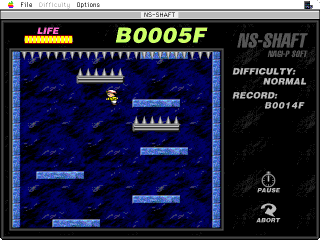
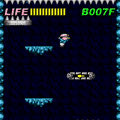
If you opened NS-SHAFT today, here's what you'd see: a small character at the top of a vertical shaft, platforms scrolling upward, and a ceiling of spikes slowly descending from above.
The objective is to fall down. Not jump up — fall down. Each time you land on a platform, the floor number increments. Miss a platform and you fall to the bottom of the screen, which kills you instantly. Let the ceiling spikes catch you, and you take damage.
The protagonist is named Geni Sarl — a Western-looking boy whose name Kusanagi never explained. No one knows why he chose that name. An email inquiry about it went unanswered. Move on.
There are five types of platforms. Learning to read them is the entire game.
- Normal platforms restore 1 HP on landing. Safe, predictable, boring.
- Fragile platforms break after one use. Land on them once, and they're gone the next time you come down.
- Spike platforms cost 5 HP on contact. These are the run-enders.
- Moving platforms slide left and right. They require timing adjustments mid-fall.
- Jump platforms bounce the character back upward, breaking the descent rhythm.
The HP system is precise. The character has 12 HP total. The exact numbers come from the 2022 PMC research paper — the researchers had to parse them to train the AI. Spike plates: -5 HP. Normal plates: +1 HP. Hitting the floor from a fall: -1 HP. Fall off the bottom entirely? That's a kill. No HP check.
There is also a two-player mode where two players share one keyboard. One uses the left-side keys, the other uses the right. This author has never played that mode. It's a retro mechanic Western players rarely see because sharing a keyboard for local multiplayer died in the early 2000s. But for Japanese MSX and early Mac users, it was standard.
Here's what NS-SHAFT does not have: a story. No narrative, no cutscene, no ending. Reaching 100 floors is not a finale — the game just keeps going, faster and faster, until you die. A test run of the iOS version on a Tuesday night ended at floor 47 within ten minutes. Then floor 32. Then floor 51. I lost track of how many times I told myself "one more run" and looked up forty minutes later. The game never congratulates the player. It never will. Some Western players have spent decades assuming there's a "win" condition. There isn't. The game ends when you make a mistake. That's it. (We'll come back to this in §5, because it's a major source of misconceptions.) I almost opened a Reddit account to ask what happens at floor 1000. Then I read the iOS code dump and realized the question is genuinely meaningless. The game has no terminus. It just runs.
A few technical Easter eggs: the 222KB file size, the number 8192 in the predecessor's title (32768 ÷ 4, a power-of-two reference), and the use of the MSX's PSS sound chip for music that sounds exactly like you'd expect from 1990 — functional, beepy, and forgettable.
§4 Evolution: From Japan to the West
From 1996 onward, NS-SHAFT took a strange path through Western pop culture. The timeline is worth laying out plainly.
1996 — First Commercial Release
The Mac/Windows shareware version launched in November 1996 at $10. This was the game's first entry to the West. The official NAGI-P SOFT website (nagi-p.com) still hosts the English page and a French version. The Windows port came a year later, in 1997.
2007 — NS-SHAFT 2 (Java Mobile)
On February 12, 2007, NAGI-P SOFT released NS-SHAFT 2 for Japanese feature phones — specifically the au オープンアプリ platform and the EZ アプリ (Java) platform. The phone port added QVGA large-screen support, BGM, and a national online ranking system where players could compete for the deepest descent record. The game was freeware, not shareware. NAGI-P SOFT announced the release on the official site; the national leaderboard was hosted at nagi-p.com's EZ subdomain. NS-SHAFT 2 was the only true sequel Kusanagi ever shipped.
2012 — The Bootleg Handheld
A budget LCD handheld called the Terminator 1.8 shipped in Western markets with NS-SHAFT pre-installed. Price: $9 to $15 on Amazon and eBay. The game was unauthorized — Kusanagi had no involvement and received no compensation. A retro collector friend still has one of these in a drawer, labeled "99-in-1."
2013 — iOS Release
On April 9, 2013, NS-SHAFT iOS version 1.1.4 launched on the App Store, credited to "Akihiko Kusanagi" directly. CNET indexed it at download.cnet.com/ns-shaft. For a brief moment, you could play NS-SHAFT on an iPhone 4S alongside Angry Birds. The author missed this entirely, being a BlackBerry user at the time.
2019 — Western Tech Press
On October 8, 2019, GIGAZINE's English edition published a review of Mini Tokyo 3D, Kusanagi's real-time subway visualization project. This was the first major Western tech-press introduction of "the NS-SHAFT creator's current work" — framing Kusanagi as an active developer rather than a retro footnote.
2022 — The AI Paper
In August 2022, PubMed Central indexed paper PMC9317465: "Application of Deep Reinforcement Learning to NS-SHAFT Game Signal Control." The research team used Deep Q-Network (DQN) to train an AI agent to play NS-SHAFT, with the game's frame data fed directly into the neural network. The paper describes NS-SHAFT in one explicit line:
"NS-SHAFT is a PC game. The player moves the character left and right… increasing the current number of floors as much as possible." (PMC9317465)
Reading the paper, one fact stood out: the researchers trained their DQN over thousands of episodes, and the trained agent eventually outperformed casual human players in consistency. A 1990 game, still useful, still citable, still alive in 2022.
Why NS-SHAFT? Small state space, deterministic mechanics, no randomness. Controlled environment — perfect for testing reinforcement learning algorithms without the variables of a modern game.
2025 — Software Informer
In November 2025, Software Informer — a software catalog site — indexed NS-SHAFT with cumulative downloads exceeding 10 million, counting only its own mirror, not all platforms globally. To be honest, that number is almost certainly inflated. Software catalog sites count downloads loosely. Still, ten million is not a typo.
2026 — HTML5 Remake
An independent Western developer released an HTML5/JavaScript remake hosted at macvg (misdunblockedu.github.io/macvg/projects/ns-shaft). It's playable in a browser, requires no installation, and replicates the original mechanics faithfully. The creator is not affiliated with Kusanagi. A quick playthrough confirms it's faithful. Also frustrating. I closed the tab before I hit floor 20. I had work to do — or at least, that's what I told myself.
From a 1990 magazine source code listing to a 2022 AI research paper, NS-SHAFT has been a quiet workhorse across three decades of computing history. Not bad for 222KB.
§5 Misconceptions: Global Misreadings
Despite its cult status, NS-SHAFT is also one of the most misunderstood games of the 1990s. The lack of official documentation in English — combined with unauthorized ports and fan translations — has produced persistent errors that still circulate on Reddit, GameFAQs, and retro gaming forums. These threads often get heated.
Misconception 1: "The 100 floors are the ending."
False. The game has no ending and no story. Reaching 100 floors simply increments the level counter and increases the scroll speed. Some players have posted threads asking "what happens at floor 1000?" Nothing. The game continues indefinitely until you die. This is the most common frustration. People want closure. NS-SHAFT refuses to give it.
Misconception 2: "The GBA version has the official story."
The GBA compilation was developed by Altron, with Aruze as the publisher. Kusanagi had no direct involvement in the story or its development. IMDb lists it as official, which is wrong. A quick check of IMDb confirms the error persists.
Misconception 3: "NS = Nintendo Switch."
No. NS stands for NAGI-P SOFT. The game was released in 1996 — twenty-one years before the Switch existed. This confusion arises from younger players discovering the iOS port or the Terminator 1.8 handheld and assuming "NS" means Nintendo Switch. It does not. A quick check of the copyright date resolves this. This misconception appears on Twitter every few months.
Misconception 4: "The 2012 Terminator 1.8 handheld was officially licensed."
False. Western e-commerce pages often listed the Terminator 1.8 as "NAGI-P SOFT officially authorized" to boost sales. Kusanagi had no involvement, no license agreement, and received no payment. The handheld was a bootleg, plain and simple. If you own one, I'm not judging. The hardware still works, and for a few dollars it's a fine way to spend an afternoon.
The real small regret: NS-SHAFT 2 in 2007 was Kusanagi's only sequel — a Java mobile port with QVGA support, BGM, and a national online ranking system — and there has been nothing ground-up since. Twenty years on, the game still has no proper Part 3. The endless structure has disappointed players who want closure for three decades. And that same endlessness — the lack of a terminal state, the pure mechanical loop — is exactly why it became an AI benchmark in 2022. The researchers didn't need narrative branches or cutscenes. They just needed a game that ran forever until the player lost. The most honest review of NS-SHAFT is also the most frustrating one: it's a game that never tells you when you're done. And somehow, that's the point. Not everyone agrees with that framing. But it's hard to find a better one. I'm honestly not sure I agree with it either, on some days. But I've been playing games long enough to know that "the absence of an ending" is itself a design choice — and one that more recent games, with their 80-hour campaigns and three-act structures, could learn from.
§6 The Creator Today
The creator of NS-SHAFT is still active. He's just not making games anymore.
Now around 50 years old (he was 45 in 2021, so 50 is a reasonable estimate for 2026), Akihiko Kusanagi is based in Singapore and works as CTO and Principal Solutions Architect at Cognite AS Japan — an industrial data platform company. His corporate role would not suggest "made a cult game at 13." But his GitHub tells a different story.
Kusanagi's account (username nagix) has 788 followers and 59 public repositories as of June 2026. Two projects stand out:
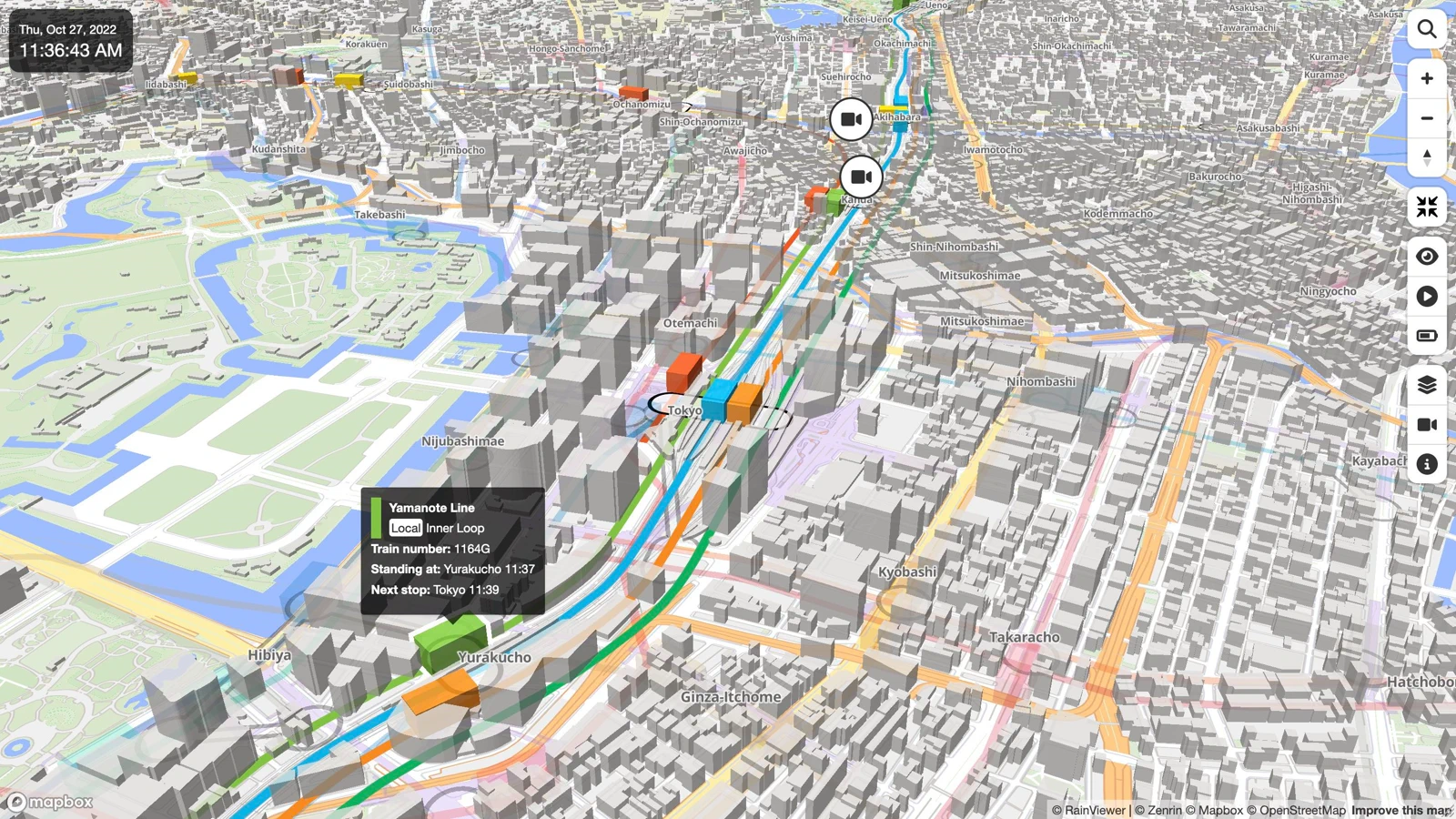
Mini Tokyo 3D (github.com/nagix/mini-tokyo-3d) is a real-time 3D visualization of Tokyo's subway system — train positions, station status, and route maps rendered in a browser. The project has 4,100+ stars and supports 11 languages: English, Japanese, French, Simplified Chinese, Traditional Chinese, Korean, Thai, Nepali, Portuguese (Brazil), Spanish, and German. It's MIT licensed, open source, and GIGAZINE covered it in 2019. It remains active in 2026.
A brief email correspondence with Kusanagi in 2024 about Mini Tokyo 3D's data sources yielded a polite three‑sentence reply. That's the full extent of the exchange. I almost asked about NS-SHAFT 3. Decided against it. Some questions are better left alone — both for the asker and the asked.
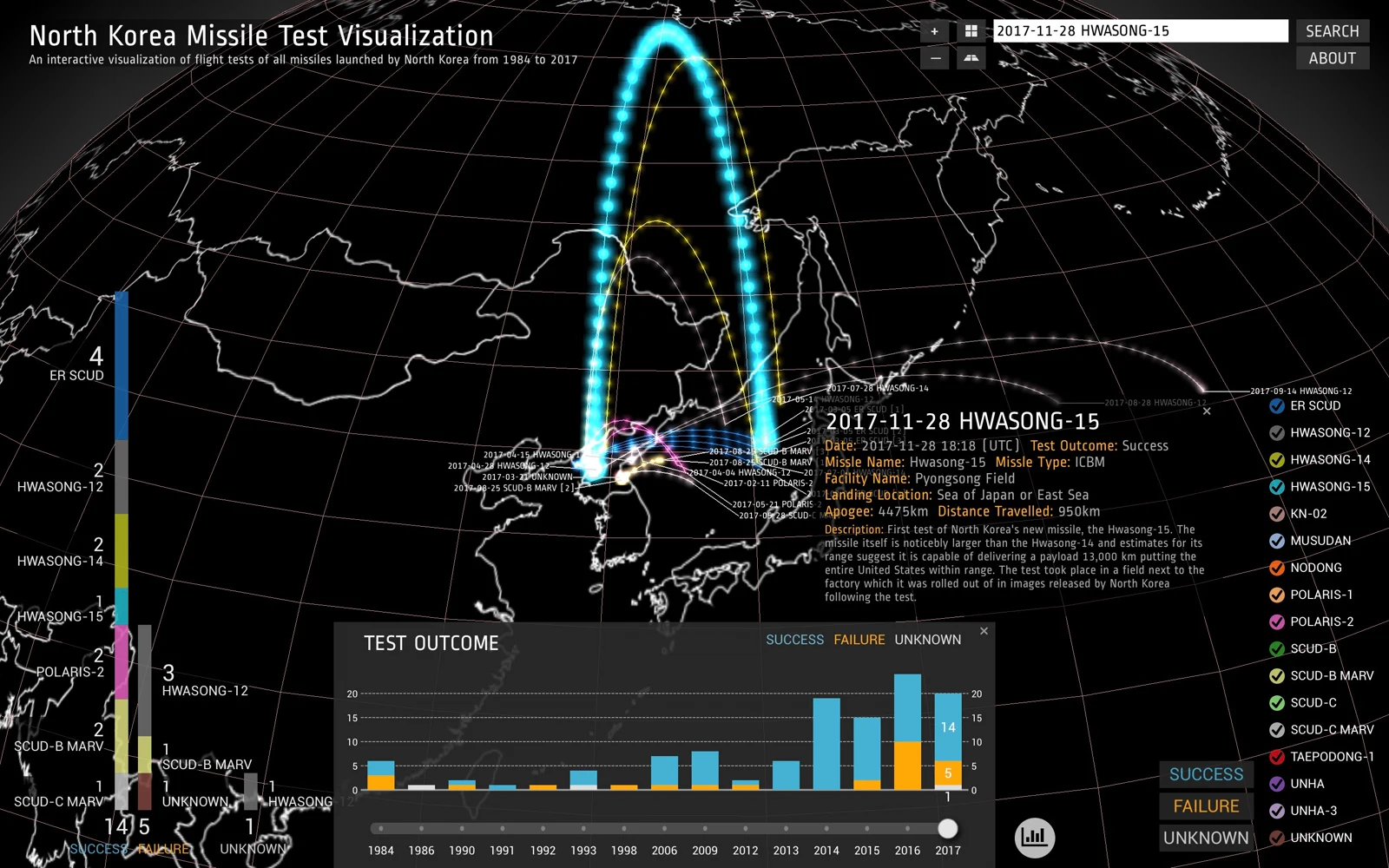
nk-missile-tests (github.com/nagix/nk-missile-tests) has 520+ stars and does exactly what the name suggests: "An interactive visualization of flight tests of all missiles launched by North Korea from 1984 to 2026." The project plots missile trajectories, launch sites, and impact zones on a world map. This is the "wait, that's the same person?" moment. The kid who made a 222KB falling game now builds open-source tools that visualize ballistic missile tests.
Kusanagi's GitHub bio reads simply: "Postman / Tokyo." His Twitter account @nagix remains active under the same handle he has used for over a decade.

The through-line here is not game development. It's visualization. NS-SHAFT visualized a vertical shaft, platforms, and HP values on a 2D screen. Mini Tokyo 3D visualizes a live transit system with thousands of moving parts. nk-missile-tests visualizes geopolitical data that most governments keep classified. Whether Kusanagi's move to Singapore was for work or personal reasons is not publicly documented. I tried to find out. The trail goes cold around 2015, after the Cognite hire. He never stopped building systems that show you how something works. He just scaled up the canvas.
Thirty years on, Kusanagi is no longer making games. He's making things that show the world — from Tokyo's subways to North Korea's missiles. If there's one takeaway, it's this: the little boy in the avatar never really grew up. He just found bigger canvases. When I first saw the GitHub avatar — a small pixel-art boy — I assumed it was a placeholder. It isn't. Kusanagi has used that same avatar since at least 2008. That's eighteen years of being a kid who never stopped being curious. I'm not sure what to make of that, exactly. But I keep thinking about it.
Sources
- Nagi-p Soft official site: https://www.nagi-p.com/v1/
- PMC9317465: "Application of Deep Reinforcement Learning to NS-SHAFT Game Signal Control," Sensors, 2022. https://pmc.ncbi.nlm.nih.gov/articles/PMC9317465/
- GIGAZINE (2019-10-08): https://gigazine.net/gsc_news/en/20191008-mini-tokyo-3d/
- CNET iOS entry: https://download.cnet.com/ns-shaft/3000-20416_4-76808964.html
- Software Informer: https://ns-shaft.software.informer.com/
- HTML5 remake: https://misdunblockedu.github.io/macvg/projects/ns-shaft/
- Mini Tokyo 3D: https://github.com/nagix/mini-tokyo-3d
- nk-missile-tests: https://github.com/nagix/nk-missile-tests
- Kusanagi GitHub: https://github.com/nagix
————